

Date: July 9, 2025
Category: Science & Tech | ISRO | Space News
India’s space journey reached another milestone today as the Indian Space Research Organisation (ISRO) successfully launched three satellites in a single day from Sriharikota. This historic achievement highlights India’s rapidly growing capabilities in multi-mission deployment, satellite technology, and commercial space ventures.
The triple launch—comprising one Earth observation satellite and two smaller communication and navigation payloads—marks a significant leap in ISRO’s push toward global competitiveness in the space economy.
🚀 What Was Launched Today?
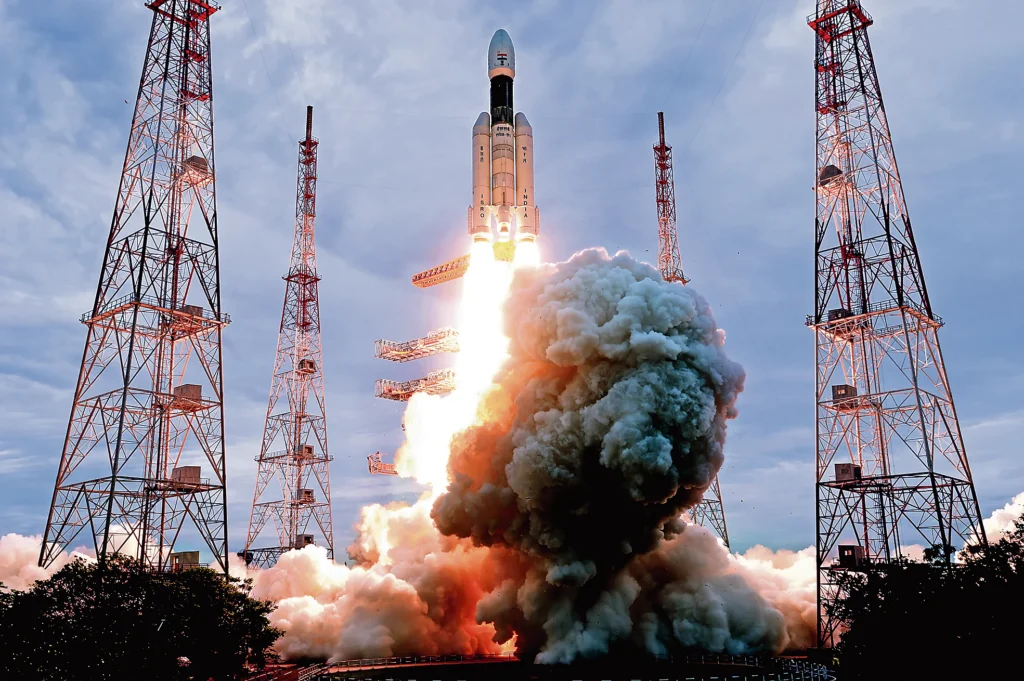
On the morning of July 9, 2025, ISRO’s trusted PSLV-C65 (Polar Satellite Launch Vehicle) lifted off from the Satish Dhawan Space Centre, carrying:
- EOS-09 (Earth Observation Satellite) – For agricultural mapping, disaster monitoring, and urban planning
- NavCom-1 – A next-gen navigation satellite for Indian GPS alternatives
- MicroSat-T – A compact communication satellite developed in partnership with a private Indian startup
The entire mission lasted under 20 minutes, with all three satellites placed in precise orbits.
📡 Mission Objectives
Each satellite serves a distinct purpose:
🛰 EOS-09 (Earth Observation Satellite)
- Equipped with multispectral imaging sensors
- Will assist in real-time crop assessment, forest cover tracking, and climate change data collection
- Supports government programs like PM-KISAN, Smart Cities, and Disaster Response
🛰 NavCom-1
- A key part of India’s NavIC (Navigation with Indian Constellation) system upgrade
- Provides accurate GPS services across India and the surrounding region
- Aims to reduce dependence on U.S.-based GPS, especially for military and aviation purposes
🛰 MicroSat-T
- Built in collaboration with SkyOrbX, an Indian aerospace startup
- Targets rural communication and emergency broadcasting
- Demonstrates India’s space-tech startup ecosystem growth
🎯 Why Is This Launch Significant?
This is the first time ISRO has launched three functional satellites in a single PSLV mission under different categories — Earth observation, navigation, and communications.
It also signifies:
- Operational flexibility of Indian rockets
- Growing public-private collaboration in the space sector
- India’s emergence as a low-cost satellite launch hub
The mission was also carbon-efficient, using green propellant innovations that ISRO has developed over the last three years.
🌐 Global Impact
This mission places India alongside the top few nations capable of multi-satellite deployment with precision and reliability.
According to Dr. Radhika Nair, senior scientist at ISRO:
“This mission reflects India’s readiness to lead in low-Earth orbit solutions. It’s not just about space—it’s about national capability, economic empowerment, and global influence.”
With the global small satellite market expected to hit $62 billion by 2030, India’s positioning in this sector is becoming increasingly strategic.
🛰 ISRO’s Future Launches in 2025
Today’s successful launch is just the beginning. ISRO’s 2025 calendar includes:
- Gaganyaan (India’s first human spaceflight) – Final uncrewed test in Q4
- Chandrayaan-4 – A return mission to the Moon’s South Pole
- Aditya-L2 – A solar observation satellite at Lagrangian point
- Multiple commercial launches for countries in Asia, Africa, and Europe
India’s private space sector is also gearing up for action, with over 50 startups now registered with IN-SPACe (Indian National Space Promotion and Authorization Center).
🇮🇳 Boost for “Make in India” & Startups
Today’s MicroSat-T success highlights the strength of Indian innovation. Built entirely within India, the satellite:
- Used locally sourced components
- Was designed by a young team of engineers under 30
- Took just 9 months from concept to deployment
The government’s support for space entrepreneurship under policies like Indian Space Policy 2023 is bearing fruit.
🌍 How This Affects You
For ordinary Indians, today’s launch means:
- Better GPS accuracy for smartphones, transport, and agriculture
- Improved disaster warning systems and emergency communication
- More startups entering space-tech, creating jobs and innovation
- Faster access to data for farmers, urban planners, and researchers
📢 Reactions on Social Media
Social media lit up with praise for ISRO:
“Three birds with one rocket! ISRO is truly India’s pride!” – @IndiaTechProud
“World should take note. India is rising in space like never before.” – @GlobalOrbitWatch
“Kudos to our brilliant scientists and engineers.” – @DesiScienceDaily
The hashtag #ISROTripleLaunch is trending across X (Twitter) and Instagram.
🧾 Conclusion
Today’s three-satellite launch by ISRO is a shining example of what modern India can achieve — scientific excellence, strategic capability, and global leadership. As the country gears up for more ambitious space missions in 2025, the world is watching closely.
From monitoring monsoons to guiding missiles, from boosting startups to mapping forests, India’s space journey is truly out of this world.